The food delivery driver job listing says $18 to $25 an hour. Your bank account, after a full week of dashing, says something closer to $10. That gap between gross pay and net pay is the single most misunderstood number in gig delivery work.
ZipRecruiter's August 2026 data puts the national average at $18.45 per hour gross for food delivery drivers. But Gridwise's tracked data from 500,000+ drivers shows the median Uber Eats driver takes home $14.07 per hour in total trip pay, tips included.
This article is for the person staring at a DoorDash or Uber Eats sign-up page right now, trying to figure out if the math works as a side gig or a full-time income source. Spoiler: it depends entirely on which costs you track and which ones you ignore.
How Much Do Food Delivery Drivers Make Per Hour in 2026?
Food delivery drivers in the U.S. gross between $15 and $25 per hour before expenses, depending on platform, city, and time of day. That number drops fast once you subtract fuel, vehicle wear, and self-employment tax.
Gridwise's September 2026 report tracked real driver data across platforms. Uber Eats drivers averaged $18.06 gross per active hour, while DoorDash drivers averaged $12.43 gross per active hour.
Uber Eats Pay Breakdown
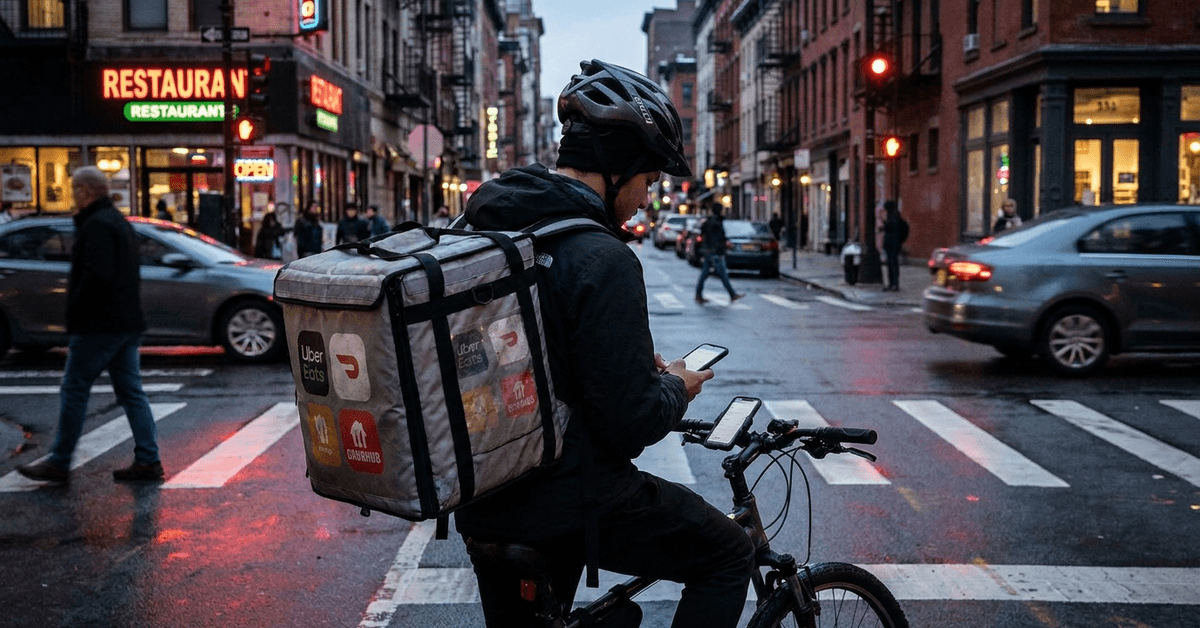
The median Uber Eats driver completes 1.70 deliveries per hour and earns $6.26 per hour in tips alone.
Tips make up close to half of per-delivery income on Uber Eats. The top 10% of drivers earn $20.83 per hour, completing 2.28 deliveries per hour.
Sunday evenings between 6pm and 8pm pay the most at $18.28 per hour on average across the platform.
DoorDash Pay Breakdown
DoorDash base pay runs $2 to $10+ per delivery. Most Dashers gross $15 to $22 per hour before expenses. After vehicle costs, the typical take-home lands around $10 to $14 an hour before income tax.
I would pick Uber Eats over DoorDash for per-hour earnings based on Gridwise's 2026 tracked data showing a $5.63 gap in average gross hourly pay between the two platforms.
That said, DoorDash has stronger market coverage in smaller cities where Uber Eats may have fewer orders.
The Expense Problem Nobody Calculates Before Signing Up
Gross pay is a fantasy number for gig drivers. The real question is what lands in your pocket after the car eats its share.
Gas and Mileage
A full-time DoorDash driver covers 300 to 500 miles per week. At roughly $0.12 to $0.20 per mile in fuel costs, that is $36 to $100 per week in gas alone.
The 2026 IRS standard mileage rate is $0.725 per mile for January through June and $0.76 per mile from July onward.
Vehicle Depreciation and Maintenance
AAA's 2026 operating cost estimate puts total vehicle costs at $0.55 to $0.75 per mile when you factor in depreciation, tires, insurance, and maintenance. A driver logging 400 miles in a week could see $220 to $300 disappear into car costs.
Self-Employment Tax
As a 1099 independent contractor, you owe 15.3% in self-employment tax on net earnings. No employer splits that with you.
A driver grossing $800 per week and driving 400 miles could net roughly $353 per week after vehicle wear and taxes, per one published earnings walkthrough. That effective rate drops to about $8 to $9 per hour on a 40-hour week.
A study of Texas gig workers cited by one earnings analysis found a median of $5.12 per hour after expenses. That number should make anyone pause before quitting a W-2 job.
Comparing Top Food Delivery Platforms in 2026
Each platform pays differently, covers different regions, and attracts a different type of driver.
| Platform | Avg. Gross/Hour | Delivery Modes | Best For |
|---|---|---|---|
| Uber Eats | $18.06 (Gridwise 2026) | Car, bike, scooter | Urban drivers, tip-heavy markets |
| DoorDash | $12.43 (Gridwise 2025) | Car, bike | Suburban coverage, smaller cities |
| Grubhub | Varies by market | Car | Scheduled shift preference |
| Instacart | Varies by market | Car | Grocery-focused, larger orders |
Uber Eats pays more per hour on average, but DoorDash has wider geographic reach across North America including suburban and rural zones.
Who Should Skip Food Delivery Gigs Entirely
Drivers with car payments above $400 per month and vehicles averaging under 25 MPG will likely lose money doing food delivery full-time. The math collapses when your vehicle costs exceed what the IRS mileage deduction can offset.
The Car You Drive Decides Your Profit Margin
A driver in a paid-off Honda Civic getting 35 MPG keeps far more per delivery than someone in a financed SUV at 18 MPG. Fuel cost per mile nearly doubles. Depreciation hits harder on newer vehicles.
I think the biggest mistake new delivery drivers make is signing up without calculating their per-mile vehicle cost first, something a 2-minute check of the IRS mileage rate page would solve.
When a W-2 Part-Time Job Pays More
If a local restaurant, warehouse, or retail store offers $15 per hour as a W-2 employee, that $15 is your take-home before income tax. No gas. No tire wear. No quarterly estimated payments.
A food delivery gig grossing $18 per hour can net less than that $15 W-2 after expenses. That comparison rarely shows up in platform marketing.
How to Earn More Per Hour as a Delivery Driver
The difference between a $9/hour net driver and a $17/hour net driver comes down to three habits.
Multi-Apping During Peak Hours
Running Uber Eats and DoorDash simultaneously during dinner rush lets you cherry-pick the highest-paying orders.
Most experienced drivers report this as the single biggest earnings boost. Sunday 6pm to 8pm is the highest-paying window on Uber Eats specifically.
Tracking Every Single Mile
The IRS mileage deduction at $0.76 per mile (July 2026 onward) is the largest tax break available to gig drivers. Drivers who track mileage consistently can cut their taxable income by 50% or more.
Apps like Gridwise and Everlance automate this. Skipping mileage tracking is like leaving a $3,000 to $5,000 annual deduction on the table.
Rejecting Low-Pay Orders
Accepting every $3 order that pops up tanks your hourly rate.
Strategic Dashers who filter for orders above $6 to $8 and stay within a tight delivery radius consistently earn in the $22 to $28 per hour gross range during peak windows, per multiple 2026 driver reports.
What the Sign-Up Process Looks Like
Getting started on most platforms takes under a week. The requirements are nearly identical across the board.
You need to meet these basics on most platforms:
- Be at least 18 years old (19 in some Canadian provinces)
- Have a valid driver's license, vehicle insurance, and a smartphone
- Pass a background check, which typically takes 3 to 7 business days
- Own or lease an eligible vehicle (some platforms allow bikes and scooters)
DoorDash's Dasher signup portal walks through the full application. Uber Eats allows both car and bike deliveries in most cities, which opens the door for drivers without a car.
One thing worth checking: your personal auto insurance policy may not cover gig-related driving.
A rideshare insurance endorsement typically costs $15 to $40 per month extra. Driving without it could void a claim if you get into an accident while on a delivery.
Tax Filing as a Food Delivery Driver
Gig delivery income is reported on a 1099-NEC form if you earn $600 or more from a single platform in a calendar year. You are responsible for both the employee and employer portions of Social Security and Medicare taxes, totaling that 15.3%.
Quarterly estimated tax payments are due in April, June, September, and January. Missing these deadlines triggers penalties. Many first-year drivers get caught by a surprise tax bill in April because they treated gross earnings as net income all year.
Keep receipts for phone bills, hot bags, phone mounts, and any delivery supplies. These are deductible business expenses on top of mileage.
Questions People Ask About Food Delivery Jobs
These come up constantly among new and prospective gig drivers.
- Q: Can you do food delivery without a car?
Yes. Uber Eats, DoorDash, and Grubhub all allow bicycle deliveries in most major cities. Bike couriers skip fuel and vehicle depreciation costs entirely, though earnings per hour tend to run lower because delivery radius shrinks. If you live in a dense urban area, biking can net more per hour than driving once you subtract car costs. - Q: Do food delivery drivers get benefits like health insurance?
No. As 1099 contractors, gig drivers receive no employer-sponsored benefits. You can purchase individual health insurance through Healthcare.gov during open enrollment. Some states have explored portable benefits legislation for gig workers, but nothing is standard across the U.S. as of 2026. - Q: Is it better to do food delivery full-time or part-time?
Part-time drivers who work only peak hours (lunch 11am to 1pm, dinner 5pm to 9pm) consistently report higher per-hour net earnings than full-time drivers. Full-time drivers fill dead hours with low-pay orders that drag down their average. My take is that 15 to 20 peak hours per week beats 40 random hours for hourly rate. - Q: How fast can you start earning after signing up?
Most platforms activate accounts within 3 to 7 business days after the background check clears. DoorDash and Uber Eats both offer instant pay or next-day deposits, so you can cash out earnings without waiting for a weekly pay cycle. - Q: Do you have to deliver food only, or can you deliver other items?
DoorDash and Uber Eats have expanded into grocery, pharmacy, and retail deliveries. These orders often pay more per trip because item counts are higher. Instacart focuses on grocery exclusively. Multi-category orders can fill slow food delivery windows.
Conclusion
The gig delivery economy pays real money, but only if you treat it like a business with trackable costs. A $14 per hour median on Uber Eats sounds modest until you compare it to a net $6 after ignoring expenses.
The drivers who profit are the ones who run their numbers before their engines. Food delivery jobs reward the strategic driver, and penalize the one who never opens a spreadsheet.